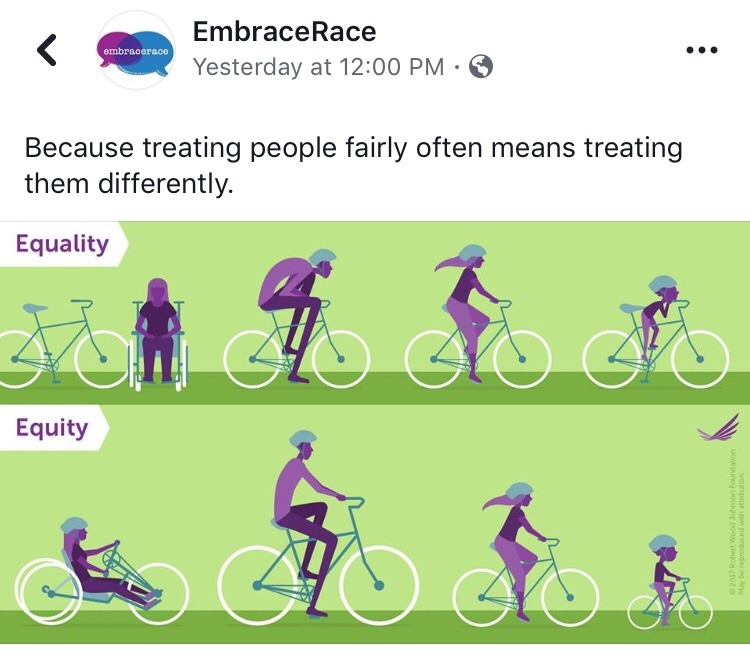
Because treating people fairly often means treating them differently.
This is something that I teach my students during the first week of school and they understand it. Eight year olds can understand this and all it costs is a box of band-aids.
I have each students pretend they got hurt and need a band-aid. Children love band-aids. I ask the first one where they are hurt. If he says his finger, I put the band-aid on his finger. Then I ask the second one where they are hurt. No matter what that child says, I put the band-aid on their finger exactly like the first child. I keep doing that through the whole class. No matter where they say their pretend injury is, I do the same thing I did with the first one.
After they all have band-aids in the same spot, I ask if that actually helped any of them other than the first child. I say, “Well, I helped all of you the same! You all have one band-aid!” And they’ll try to get me to understand that they were hurt somewhere else. I act like I’m just now understanding it. Then I explain, “There might be moments this year where some of you get different things because you need them differently, just like you needed a band-aid in a different spot.”
If at any time any of my students ask why one student has a different assignment, or gets taken out of the class for a subject, or gets another teacher to come in and help them throughout the year, I remind my students of the band-aids they got at the start of the school year and they stop complaining. That’s why eight year olds can understand equity.
some stuff isn’t just a trope, you know? in the movies, we’re introduced to women who are “experts” who have trained for years, who live and breathe and are willing to die for whatever the male main character has never even experienced before. and then he takes the reigns and upstages her, instantly, with a little bit of friendly bewilderment because, come on, it’s not antifeminist, he’s just good, he’s standing there having shown he’s actually more powerful than she’ll ever be – and we buy it. and then we go home and when we live and breathe something we still ask ourselves. “am i actually good at this? or is some fool going to walk into this presentation eighteen minutes in and offer a sarcastic and biting correction?” we wait for the man to show up and prove that, despite awards and training and an excellent job position, we’re actually just secretly incompetent.
the trope isn’t just setting up for us “this man is good at what he does” – the fact that the trope demands our male hero upstage the woman says: even an incompetent man will always be better than the best woman. he could have upstaged the sage boss or whatever other male in power exists in the movie. but he doesn’t. he upstages the woman to earn his pack order because she is, intrinsically, the weakest link. the real fight will be man against man. it always is.
and i wish, i wish it stopped outside of the theater. but the number of men who try (gently) to assure me that they’re actually better at what i have multiple degrees and years of experience in – it tells me it worked. men are always looking to be the hero, to interrupt, to upstage, to flip the woman on her back and expose her to all your fellow men – see! for someone who has been doing this forever, she’s just another woman. i am reminded by a man this is called mansplaining. i said “it’s a system of silencing women” and he said, “no, it’s just an accident.” in the movie, he sees himself pointing to my equation on the board, having just walked in. “here’s the flaw,” he says. in the real life, i’m too frustrated to speak. in the movie, he’s inevitably right.
elle woods flipping her hair and saying what, like it’s hard? was a funny line. it’s funny because in every other movie, it’s said by a guy.
Male student, your unwanted advances and creepy staring are distracting the female students. Go home until you can get yourself together and have some self-control.
There’s a very powerful movement going on right now on the internet that, you know, women are kind of coalition building in a very cool way. I’m talking about #nomakeup. You can search it if you don’t believe me, but some brave women are mustering up all their courage, and they will post a photo onto the internet in which they are wearing no makeup whatsoever. I’m serious. But when they post the photos, they’ll always make a big announcement in the caption, they’ll be like “In the following photograph, I, Cassandra, am not wearing any makeup!”
You can’t pick and choose what parts of feminism you want. You can’t support your queer sisters but not your trans sisters. You can’t support your fat sisters but not your sisters of colour. Being a feminist means creating a positive and equal space for women. The second you start excluding women based on which characteristics you do or do not find appealing you have defeated the whole point of being a feminist.











 LemonGrenade