Alright so I’ve made a theory about Over the Garden Wall. When Wirt and Greg travel with Beatrice to Pottsfield I felt like I had heard the name before that’s when I realized something.
In history people who where highly in debt or where poor and couldn’t afford to buried in a cemetery they where buried in unmarked graves called Potters Fields (at most you where given a number on a small stone like this)
… So when Wirt and Greg are digging and finding these skeletons the reason they are not marked graves is because it’s a potter’s field hence the name of the town.
This is just something I thought of when watching the series and I must say it’s a wonderful series and has tons of historical references for history nerds like me
Tag: over the garden wall


In OtGW, was the Unknown real? Or was it all in Wirt’s mind?
Thanks for the ask! UuU I’ve been wanting to gush about this show (even more than I already have haha)
First and foremost, no, I don’t think The Unknown was all in Wirt’s mind, or that it was all a coma dream or whatever. This doesn’t make sense with the content of the story. If it’s all Wirt’s dream, why does Greg know about everything too? Why is Jason Funderburker (the frog) still with them, and why does he still have the bell? Why do the other kids seem shocked to see the frog glowing from his stomach if it wasn’t happening?
As many people have theorized already, The Unknown is most likely a form of Limbo; a place that lost souls teetering between life and death reside and wander around.
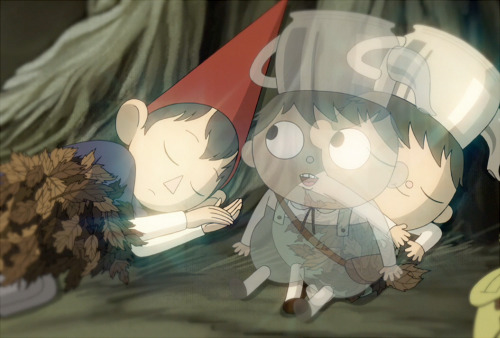
Depending on their choices they either make it back to the world of the living, make it to a heaven sort of place (like Greg reached in episode 8; he only returned because he didn’t want to leave Wirt behind)
or are consumed by the Beast to be forgotten and lost
There’s also the fact that for the majority of the show, they are in a wood that is in the middle of autumn, and by the end it has become winter time. Autumn is the time in-between summer (the time of most life) and winter (which tends to get associated with death).
Another constant is the half moon. Whenever we get to see the moon, it is in the middle of its cycle, which I interpret as another symbol of the state the boys are in.
It’s even a half moon before they go over the wall and into The Unknown. This reinforces the symbolism because it’s like time for them just… stopped.
And when you can’t see the moon anymore, or even any of the sky, is when Wirt and Greg are closest to proper death; when winter has come, and it’s started to snow.
I feel like the “pockets of story” that Wirt and Greg encountered are the people that have settled down, so to speak. They are the people buried in the graveyard, and so they have a place to stay. They don’t have to wander through this wood of literal lost souls because they already have a designated home.
(One of the biggest examples people have brought up is Quincy Endicott. You can see his name on the gravestone that Greg is hiding behind)
The graveyard itself is called The Eternal Garden. The wall the boys jumped over could be taken as them going “over the wall” into what humans consider The Unknown – the place that is there when you die.
A bunch of other things have been brought up by others: the allusions to Dante’s Inferno, the two cents being like the price to cross the river Styx, Pottsfield being a representation of a Potters Field and so many other clues and hints.
I highly, highly recommend a rewatch, because you will catch so many more little details. It’s super satisfying to look at everything in this show!
The fact that Over the Garden Wall leaves you a lot of room for interpretation is one of the best parts, and it lets you keep thinking for hours or days afterward. It’s really beautifully done, and I haven’t seen a story do its telling as well as this little series has in a long, long time.



McLoughlin Bros. Inc. was an American publishing firm active between 1828 and 1920 in New York. During their century long rein in the business, they played a pivotal role in defining how children’s stories, games, and toys would be stylized at the time, with most of their projects revolving around the repackaging of classic stories (Mother Goose fables, nursery rhymes, etc) into suitable bedtime stories and elementary literature. In the episode Lullaby in Frogland (a reference to the widely celebrated jazz standard Lullaby in Birdland, made popular by Ella Fitzgerald) the toy steamboat humorously named McLaughlin Bros. is first seen being played with by who we can presume to be two of Beatrice’s brothers during the musical prologue to the series, and later the boat appears again as not a toy, but a full-sized ferry manned by bipedal frogs the size of human children. Many of the fantastic themes of Over the Garden Wall are given some form of explanation and closure, but others such as the mysterious riverboat are not so black and white.
The accompanying lyrics to the young boys seated by the river playing with their toy:
but where have we come
and where shall we end?
if dreams can’t come true
then why not pretend?The ferry is one of the many strange passages in Wirt and Greg’s journey through the Unknown. The Beast’s ever-lurking presence makes sense, as he is a creature of shadows and personified self-doubt and he goes wherever his prey goes. He is in essence a part of them, but even others such as the Woodsman who do not share this space-defying existence always seem to be within a stone’s throw of the two brothers no matter how far they venture. Like all methods of travel in the Unknown the boat takes them far, far away and doesn’t at the same time. The ferry is an embodiment of American nostalgia, a relic of Mark Twain’s romantic storytelling, all while being shrouded in a fog of mystery that you’d might not even notice if you’d blinked at the wrong moment.
All of the boys’ journeying is mere wandering, and yet it has a quality of undeniable purpose to it. While ultimately the Unknown is theoretically endless and the only escape from the Beast comes from self-assurance within one’s own, that is not to say the journey does not play a pivotal role in reaching this understanding.

 LemonGrenade